


In modern elastomer manufacturing, two technologies dominate high-performance production: rubber injection molding and liquid silicone rubber molding (LSR). While they may appear similar at a surface level—both involve injecting elastomer materials into molds—their material chemistry, processing systems, machines, and end-use applications are fundamentally different.
Understanding these differences is critical for engineers, procurement teams, and manufacturers because selecting the wrong process can lead to higher costs, production instability, or product failure.
This article provides a complete, engineering-level comparison of both technologies, including processes, machines, cost structure, applications, and decision-making frameworks.
1. What Is Rubber Injection Molding?
Rubber injection molding is a manufacturing process in which preheated rubber compounds are injected into a closed mold cavity under high pressure, then cured through a chemical reaction known as vulcanization.
The process is widely used in industrial production because it offers strong mechanical performance and cost efficiency.
Common rubber materials:
- NR (Natural Rubber)
- NBR (Nitrile Rubber)
- EPDM (Ethylene Propylene Rubber)
- SBR (Styrene Butadiene Rubber)
- FKM (Fluoroelastomer)
These materials are selected based on required properties such as oil resistance, weather resistance, or mechanical strength.
2. Rubber Injection Molding Process Explained
The rubber injection molding process typically includes four stages:
Step 1: Material Preparation
Rubber is prepared in strip or pellet form and may be preheated to improve flow behavior.
Step 2: Injection
Material is fed into a rubber injection molding machine and injected into the mold under high pressure.
Step 3: Vulcanization
Inside the heated mold (140°C–200°C), sulfur or peroxide creates cross-linking between polymer chains.
Step 4: Demolding
After curing, the part is ejected and may undergo trimming or post-processing.
Typical Process Parameters
| Parameter | Range |
|---|---|
| Mold temperature | 140°C–200°C |
| Injection pressure | 50–150 MPa |
| Cycle time | 30 sec – 10 min |
| Shrinkage | 1.5% – 3% |
3. Rubber Injection Molding Machine: Structure and Working Principle
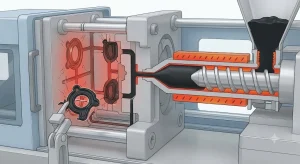
A rubber injection molding machine is designed specifically for high-viscosity elastomer processing and vulcanization control.
Main components:
- Injection unit (screw or plunger system)
- Clamping unit (100–3000+ ton force)
- Heating system (oil or electric heating)
- Control system (PLC/HMI)
Working cycle:
- Feeding rubber material
- Plasticization and heating
- High-pressure injection
- In-mold curing (vulcanization)
- Demolding
Modern machines often use closed-loop control systems to maintain stability and reduce defect rates below 2%.
4. What Is Liquid Silicone Rubber Molding (LSR)?
Liquid silicone rubber molding (LSR) is a precision injection process using a two-component liquid silicone system that is mixed and injected into a heated mold, where it cures through a platinum-catalyzed reaction.
LSR material system:
- Part A: Silicone base polymer
- Part B: Platinum catalyst
Once mixed in a 1:1 ratio, the material flows easily into molds and cures rapidly under heat.
5. Liquid Silicone Molding Process Explained
Step 1: Metering and Mixing
Precise dosing pumps mix Part A and B with ±1% accuracy.
Step 2: Injection
Material is injected into a mold through a cold runner system, preventing premature curing.
Step 3: Mold Filling
Low viscosity allows perfect replication of micro-details.
Step 4: Heat Curing
At 120°C–180°C, silicone cures via platinum addition reaction.
Step 5: Demolding
Parts are ejected with minimal or no post-processing.
LSR Process Advantages vs Rubber
| Feature | LSR Molding | Rubber Molding |
|---|---|---|
| Material form | Liquid | Solid |
| Runner system | Cold runner | Hot runner |
| Curing | Addition reaction | Vulcanization |
| Waste | Very low | Medium |
| Cleanliness | Medical grade | Industrial grade |
6. Silicone Rubber Moulding Process Characteristics
The silicone rubber moulding process is widely used in precision industries due to its unique properties:
- No toxic by-products during curing
- Excellent temperature resistance (-50°C to 250°C)
- High flexibility and transparency
- Suitable for cleanroom production
However, silicone has lower tear strength compared to rubber and higher material cost.
7. Rubber vs Silicone Injection Molding: Key Differences
Material and Chemistry
Rubber uses sulfur/peroxide vulcanization, while silicone uses platinum-catalyzed curing. This leads to very different performance characteristics.
Engineering Comparison Table
| Feature | Rubber Injection Molding | Silicone Molding |
|---|---|---|
| Strength | High | Medium |
| Heat resistance | Medium | Excellent |
| Elastic recovery | Good | Excellent |
| Tear resistance | High | Medium |
| Cost | Low | High |
| Precision | Medium | High |
Process Differences
- Rubber requires hot runners and vulcanization
- Silicone uses cold runners and clean curing
- Silicone offers higher dimensional accuracy
8. Applications Comparison
Rubber Injection Molding Applications:
- Automotive seals and gaskets
- Hydraulic and pneumatic systems
- Industrial vibration dampers
- Fuel-resistant components
Silicone Molding Applications:
- Medical devices and tubing
- Baby products
- Electronics sealing components
- Wearable devices
Conclusion
Rubber injection molding and liquid silicone rubber molding are not competing technologies but complementary solutions.
Rubber dominates in high-strength, cost-sensitive industrial applications, while silicone leads in precision, cleanliness, and regulated environments.
The correct selection depends on engineering priorities such as performance requirements, compliance standards, production scale, and lifecycle cost—not simply material preference.