


1. Introduction to the Vulcanisation of Rubber Process
Rubber is one of the most versatile engineering materials used in modern manufacturing, but in its natural state it has significant limitations. Raw rubber is soft, sticky, sensitive to temperature changes, and lacks the mechanical strength required for demanding industrial applications. The rubber vulcanization process was developed to overcome these weaknesses, transforming rubber into a durable, elastic, and highly reliable material.
Today, the vulcanisation of rubber process is considered one of the most important advancements in polymer science. Nearly every rubber product—from automobile tires and industrial seals to conveyor belts and medical components—depends on vulcanization to achieve the required performance characteristics. Without this process, many of the rubber products used in transportation, manufacturing, construction, and consumer goods would simply not function effectively.
At its core, vulcanization involves heating rubber with curing agents, most commonly sulfur, under controlled conditions of temperature and pressure. During this process, chemical bonds form between individual polymer chains, creating a three-dimensional network structure. This transformation dramatically improves strength, elasticity, abrasion resistance, and thermal stability.
The significance of in vulcanization of rubber, the molecular structure of the material changes permanently. Rather than behaving like a soft thermoplastic material, the rubber becomes an elastomer capable of stretching repeatedly and returning to its original shape. This unique combination of flexibility and durability is what makes vulcanized rubber indispensable across industries.
Modern manufacturers carefully control factors such as rubber vulcanization temperature, curing time, pressure, and chemical formulation to achieve the desired material properties. Depending on the application, manufacturers may use traditional sulfur curing systems or adopt non sulphur vulcanization of rubber techniques such as peroxide, resin, or radiation curing.
According to industry studies, properly vulcanized rubber can exhibit tensile strength improvements of more than 500% compared to uncured rubber, while also significantly increasing wear resistance and service life. These benefits explain why vulcanization remains the foundation of the global rubber industry more than 180 years after its discovery.
In this comprehensive guide, we will explore the vulcanization of rubber definition, examine the vulcanization of rubber chemistry, discuss curing temperatures and methods, compare sulfur and non-sulfur systems, and review the industrial applications that rely on this essential manufacturing process.
2. Vulcanization of Rubber Definition: What Does It Mean?
The vulcanization of rubber definition refers to a chemical process where rubber is heated with sulfur or other curing agents to form a cross-linked molecular network.
Key transformation:
- Raw rubber → soft, sticky, weak
- Vulcanized rubber → strong, elastic, stable
What changes during vulcanization?
- Polymer chains become chemically linked
- Material becomes less plastic and more elastic
- Strength and durability increase significantly
Comparison Table
| Property | Raw Rubber | Vulcanized Rubber |
|---|---|---|
| Strength | Low | High |
| Elasticity | Poor | Excellent |
| Heat Resistance | Weak | Strong |
| Durability | Low | High |
3. Vulcanization of Rubber Chemistry
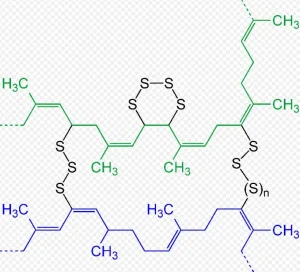
The vulcanization of rubber chemistry is based on cross-link formation between polymer chains (mainly polyisoprene in natural rubber).
Molecular mechanism:
During heating, sulfur reacts with carbon-carbon double bonds, forming bridges between chains.
Process stages:
- Activation of curing agents
- Formation of sulfur cross-links
- Development of 3D network structure
Types of sulfur cross-links:
- Polysulfidic bonds → high flexibility
- Disulfidic bonds → balance of strength and stability
- Monosulfidic bonds → high heat resistance
Role of additives:
- Accelerators: speed up curing
- Activators (ZnO, stearic acid): improve efficiency
- Fillers: enhance strength and wear resistance
4. How Does Rubber Vulcanization Work? (Industrial Process)
The industrial vulcanisation of rubber process includes several key stages:
Step 1: Raw material selection
Rubber types include NR, SBR, NBR, EPDM, silicone, and FKM depending on application.
Step 2: Compounding
Ingredients such as sulfur, accelerators, fillers, and antioxidants are mixed using:
- Banbury mixers
- Two-roll mills
Step 3: Shaping
Methods include:
- Injection molding
- Compression molding
- Extrusion
Step 4: Curing (Vulcanization)
Heat + pressure + time trigger cross-linking reactions.
Step 5: Cooling and finishing
Products are stabilized, trimmed, and inspected.
5. Rubber Vulcanization Temperature
Temperature is one of the most critical factors in vulcanization.
Typical curing temperature ranges:
| Rubber Type | Temperature Range |
|---|---|
| Natural Rubber | 140–160°C |
| SBR | 150–180°C |
| NBR | 150–190°C |
| EPDM | 160–200°C |
| Silicone | 170–220°C |
| FKM | 180–230°C |
Effects of temperature:
- Too low → incomplete curing
- Optimal → strong cross-link network
- Too high → degradation or reversion
Proper temperature control ensures consistent quality and performance.
6. Sulfur Vulcanization (Main Industrial Method)
Sulfur vulcanization is the most widely used method, accounting for the majority of global rubber production.
Components:
- Sulfur (cross-linking agent)
- Accelerators
- Activators (ZnO, stearic acid)
Types of systems:
- Conventional (CV): high elasticity, used in tires
- Semi-Efficient (Semi-EV): balanced performance
- Efficient (EV): high heat resistance
Advantages:
- Low cost
- Excellent elasticity
- Strong fatigue resistance
- Mature industrial technology
7. Non Sulphur Vulcanization of Rubber (Alternative Systems)
Some applications require higher thermal or chemical resistance, leading to alternative curing systems.
7.1 Peroxide vulcanization
- Excellent heat resistance
- Used in EPDM and electrical applications
7.2 Resin vulcanization
- High thermal stability
- Used in specialty industrial components
7.3 Metal oxide curing
- Used for chloroprene and fluoroelastomers
- Excellent chemical resistance
7.4 Radiation vulcanization
- Uses electron beam or gamma rays
- Clean and fast process
Comparison:
| Feature | Sulfur | Non-Sulfur |
|---|---|---|
| Cost | Low | Higher |
| Heat Resistance | Medium | High |
| Flexibility | High | Medium |
| Chemical Resistance | Good | Better |
8. Rubber Injection Molding Machine and Vulcanization Process Integration
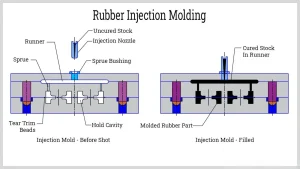
The rubber injection molding machine is one of the most advanced systems in modern rubber manufacturing because it integrates forming and vulcanization in a single continuous process.
Unlike compression molding, where shaping and curing are separate steps, injection molding performs vulcanization directly inside a closed heated mold.
8.1 How Vulcanization Works Inside Injection Molding Machines
The process includes:
- Rubber is plasticized in the injection barrel
- Material is injected into a heated mold
- Mold temperature is controlled at curing level
- Sulfur or peroxide reactions begin
- Cross-linking occurs inside mold cavity
- Fully vulcanized product is ejected
Vulcanization happens inside the machine, not after molding.
8.2 Why Injection Molding Improves Vulcanization Quality
Advantages:
- Precise temperature control
- Uniform cross-link density
- Faster cycle times
- Reduced human error
- Lower scrap rate
8.3 Injection Molding vs Traditional Vulcanization
| Feature | Compression Molding | Injection Molding |
|---|---|---|
| Process integration | Separate steps | Integrated |
| Temperature control | Medium | High precision |
| Productivity | Low | High |
| Consistency | Moderate | Excellent |
| Waste | Higher | Lower |
8.4 Industrial Applications
- Automotive seals
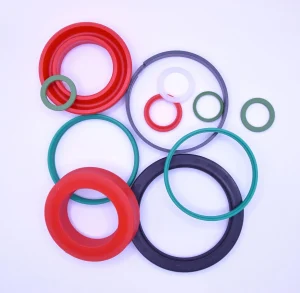
- O-rings
- EPDM weather strips
- Silicone rubber parts
- Electrical insulation components
This method is now a standard production technology in automotive manufacturing.
9. Industrial Applications of Vulcanized Rubber
Vulcanized rubber is essential in nearly every industry.
Automotive:
- Tires
- Seals
- Engine mounts
- Hoses
Industrial systems:
- Conveyor belts
- Hydraulic hoses
- Gaskets
Electrical:
- Cable insulation
- Connectors
- Protective coatings
Aerospace:
- Fuel system seals
- Vibration dampers
Medical:
- Tubing
- Sterile seals
- Equipment components
Construction:
- Expansion joints
- Waterproof membranes
- Bridge bearings
Conclusion
The vulcanisation of rubber process is a cornerstone of modern materials engineering. Through controlled chemical cross-linking, raw rubber is transformed into a durable, elastic, and high-performance material suitable for demanding industrial applications.
Understanding the vulcanization of rubber chemistry, the importance of rubber vulcanization temperature, and the differences between sulfur and non-sulfur systems allows manufacturers to design rubber products with precise performance characteristics.
From automotive tires to aerospace seals, vulcanized rubber continues to play a critical role in global industry. As curing technologies advance toward more sustainable and high-performance systems, vulcanization will remain an essential process in polymer science and industrial manufacturing for decades to come.