

In the global rubber manufacturing industry, choosing the right rubber molding equipment directly impacts production efficiency, product quality, and long-term operating cost. Two of the most widely used technologies today are the traditional hydraulic press (molding press) and the modern rubber injection molding machine.
As automation becomes the industry standard, more manufacturers are upgrading from hydraulic systems to advanced injection molding solutions. This article provides a detailed comparison to help you choose the right rubber production technology.
What Is a Hydraulic Press in Rubber Molding Equipment?
A hydraulic press (rubber molding press machine) is a traditional forming system that uses pressure and heat to shape rubber materials inside a mold.
It has been widely used for decades in small and medium-scale rubber production.
Key Features of Hydraulic Press Machine:
- No automatic injection system
- Manual rubber loading required
- Simple structure and lower initial cost
- Suitable for low-volume production
Disadvantages in Modern Production:
Although widely used, hydraulic press systems have several limitations:
- ❌ Low production efficiency
- ❌ High dependence on manual labor
- ❌ Inconsistent product quality
- ❌ Higher defect rate due to human operation
- ❌ Increased long-term production cost
Because of these issues, many factories are now replacing hydraulic presses with automation-based solutions.
What Is a Rubber Injection Molding Machine?
A rubber injection molding machine is an advanced automated rubber molding equipment designed for high-precision and high-efficiency production.
It injects pre-heated rubber material directly into molds under controlled conditions, ensuring consistency and accuracy.
Core Systems of Rubber Injection Molding Machine:
✔ Mobile Injection System
Ensures accurate, uniform rubber filling for each cycle.
✔ Automatic Feeding System (FIFO)
First-In First-Out structure guarantees stable material flow and consistent quality.
✔ Advanced Clamping System
Improves mold stability and reduces production variation.
✔ Cold Runner Optimization
Reduces waste and improves material utilization efficiency.
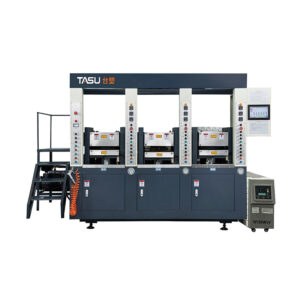
Rubber Injection Molding Machine vs Hydraulic Press
The difference between these two types of rubber molding equipment is significant in real production environments.
✔ Production Efficiency
- Hydraulic Press: Low efficiency, manual operation required
- Rubber Injection Molding Machine: High automation, up to 100% increased capacity
✔ Product Quality
- Hydraulic Press: Inconsistent density and surface finish
- Injection Machine: Uniform structure, better surface detail, improved wear resistance
✔ Labor Requirement
- Hydraulic Press: High dependency on skilled labor
- Injection Machine: Minimal operator requirement, easier recruitment
✔ Production Cost
- Hydraulic Press: Higher long-term cost due to labor and waste
- Injection Machine: Lower cost through automation and material savings
✔ Process Stability
- Hydraulic Press: Sensitive to human operation
- Injection Machine: Stable, repeatable, and fully controlled process
Advantages of Modern Rubber Injection Molding Machine
Upgrading to a rubber injection molding machine brings major improvements across the entire production line.
✔ Higher Output Efficiency
Production capacity can increase significantly, often doubling output compared to hydraulic press systems.
✔ Improved Product Consistency
- Better dimensional accuracy
- Uniform density distribution
- Reduced defect rate
✔ Material & Energy Savings
- Lower rubber waste
- Reduced electricity consumption
- Optimized material usage
✔ Smart Manufacturing Capability
Modern rubber injection systems integrate well into automated production lines, supporting Industry 4.0 upgrades.
Workforce and Factory Environment Improvement
One of the biggest challenges in traditional rubber molding equipment is labor dependency.
Hydraulic presses require:
- Heavy manual work
- Skilled operators
- Physically demanding environment
In contrast, rubber injection molding machines:
- Reduce labor intensity
- Remove strict gender and age limitations
- Improve workshop working conditions
- Make recruitment easier and more flexible
This is especially important in regions facing labor shortages.
Why Manufacturers Are Switching to Rubber Injection Molding Machines
The global trend clearly shows a shift from hydraulic press systems to automated rubber molding equipment.
Key Drivers:
- Rising labor costs
- Demand for higher production efficiency
- Increasing quality standards
- Need for stable mass production
- Environmental and energy-saving requirements
As a result, rubber injection molding machines are becoming the preferred solution for modern manufacturers.
Conclusion
The comparison between the traditional hydraulic press and the modern rubber injection molding machine clearly reflects the ongoing transformation in the rubber molding industry. While hydraulic press systems still offer a lower initial investment and remain suitable for simple or low-volume applications, their limitations in efficiency, consistency, and labor dependency make them less competitive in today’s high-demand manufacturing environment.
In contrast, the rubber injection molding machine represents a more advanced and automated rubber molding equipment solution that delivers higher productivity, improved product quality, and lower long-term operating costs. For manufacturers aiming to scale production, improve stability, and reduce reliance on manual labor, upgrading to rubber injection technology is a strategic and future-oriented choice.