


Choosing a rubber moulding machine is rarely just a question of machine size or price. The better question is what kind of rubber part you need to make, how often you need to make it, and how much variation your customer will accept.
For rubber soles, seals, gaskets, automotive parts and industrial rubber components, the machine has a direct effect on cycle time, flash, labour cost, curing stability and scrap rate. A press that looks inexpensive at the quotation stage can become costly if it needs too much manual handling or cannot hold stable moulding conditions.
This guide compares injection, compression and transfer moulding in practical terms, so buyers can narrow down the right equipment before speaking with a supplier. For factories that need repeatable production and stronger process control, TASU’s rubber injection molding machine range is a strong starting point.
What Does a Rubber Moulding Machine Do?
Rubber moulding machines shape uncured rubber compound inside a heated mould. During the cycle, the machine applies pressure and heat so the rubber fills the cavity, vulcanises and forms the finished part.
The word “moulding” is common in the UK, Europe, India and many Commonwealth markets. “Molding” is the American spelling. In international B2B search, both terms matter: a buyer may search for rubber moulding machine, rubber molding machine, rubber injection moulding machine or rubber injection molding machine and expect similar equipment results.
Typical products include:
- Rubber footwear components and outsoles
- O-rings, seals and gaskets
- Automotive rubber parts
- Electrical insulation parts
- Rubber pads, rollers and wheels
- Rubber bonded metal parts
- Custom moulded rubber products
The Three Main Machine Types
Most rubber moulding projects fall into one of three equipment groups: injection, compression or transfer. None is automatically best. Each one solves a different production problem.
Rubber Injection Moulding Machine
Rubber injection moulding uses an injection unit to push rubber compound into a closed heated mould. Because the material is delivered under controlled pressure, the process is well suited to repeat production and products that need consistent filling.
Factories often choose rubber injection moulding machines for:
- Rubber soles and footwear parts
- Automotive seals and gaskets
- Multi-cavity rubber products
- Rubber bonded metal parts
- Electrical and insulation components
- Medium-to-high-volume industrial parts
The main advantage is process control. Injection pressure, shot volume, mould temperature and curing time can be managed more consistently than in many manual compression processes. That usually means fewer operator-dependent results and better daily output.
This option usually makes sense when production volume is steady, labour cost matters, or the product has quality requirements that cannot depend on hand-loaded preforms.
Rubber Compression Moulding Machine
Compression moulding is the traditional route for many rubber parts. The operator places a measured rubber preform into the mould, then the machine closes and cures the material under heat and pressure.
This method still has a place, especially when:
- The part shape is simple
- The product is thick or heavy
- Production volume is modest
- The budget is limited
- Tooling simplicity matters more than cycle speed
The trade-off is manual variation. Preform weight, placement, mould loading and trimming can affect the final part. For some products, that is acceptable. For tight-tolerance seals or high-volume production, it may become a bottleneck.
Rubber Transfer Moulding Machine
Transfer moulding sits between compression and injection moulding. Rubber is loaded into a transfer chamber, then pushed through runners into the mould cavity.
This process can be useful for insert moulding, electrical rubber parts and some sealing products where controlled flow is needed, but a full injection moulding setup may not be the preferred route.
Compared with compression moulding, transfer moulding usually gives better material flow. Compared with injection moulding, it may still involve more manual preparation and different tooling considerations.
Injection vs Compression vs Transfer Moulding
| Factor | Injection Moulding | Compression Moulding | Transfer Moulding |
|---|---|---|---|
| Best for | Repeat production and complex parts | Simple, thick or lower-volume parts | Inserts and controlled-flow parts |
| Labour demand | Lower with automation | Higher | Medium |
| Cycle consistency | Strong | More operator-dependent | Better than compression |
| Tooling cost | Usually higher | Usually lower | Medium |
| Material filling | Controlled injection | Compression from preform | Transferred through runners |
| Common products | Soles, seals, auto parts, industrial rubber | Pads, blocks, simple parts | Inserts, electrical parts, seals |
For many modern rubber factories, injection moulding becomes attractive once order volume, quality expectations and labour costs rise. Compression moulding remains useful when the part is simple and the investment target is conservative.
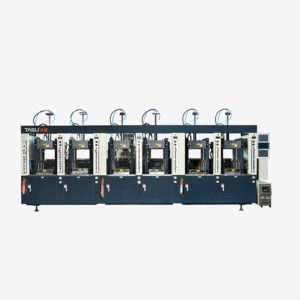
How to Choose the Right Rubber Moulding Machine
Start with the product, not the machine catalogue.
A supplier should ask for the product drawing, rubber material, part weight, mould size, cavity number, tolerance requirement and expected daily output. Without those details, any machine recommendation is mostly guesswork.
Important selection points include:
- Clamping force for the projected mould area
- Injection volume or preform capacity
- Mould opening stroke and platen size
- Heating accuracy and curing stability
- Hydraulic system reliability
- Automation level
- Operator workflow
- Spare parts and after-sales support
- Experience with similar rubber products
If the project involves high-volume rubber soles, seals, gaskets or automotive components, injection moulding should be evaluated carefully because the long-term cost per part may be lower than with a cheaper press.
When Injection Moulding Is Usually the Better Choice
Rubber injection moulding is often the better direction when the factory needs:
- Stable part weight
- Lower flash and trimming work
- Better filling of complex cavities
- Multi-cavity production
- Lower manual operation
- Repeatable process settings
- Faster cycle planning
- Scalable production
The machine investment may be higher, but the return can come from reduced scrap, fewer operators, shorter cycles and more predictable delivery.
When Compression Moulding Still Makes Sense
Compression moulding is not outdated. It can be a sensible choice for lower-volume parts, large simple products, prototype runs or projects where the moulding process does not justify a higher automation investment.
The key is honesty about production reality. If operators can manage the process and the customer accepts the tolerance level, compression moulding may be enough. If quality problems, flash and slow cycles start eating margin, it is time to review injection moulding.
Moulding vs Molding: Why Both Terms Appear
International buyers often use different spelling depending on region. In the UK, Europe, India and many Commonwealth markets, rubber moulding machine and rubber injection moulding machine are common terms. In the United States, buyers are more likely to use rubber molding machine and rubber injection molding machine.
For manufacturers selling globally, both terms point to the same equipment category. The important point is to match the machine to the rubber product, mould design and production target.