


Automotive rubber parts require stable dimensions, reliable performance and repeatable production quality. A rubber injection molding machine can produce many auto components, including seals, gaskets, bushings, vibration dampers, protective covers and rubber bonded metal parts.
Compared with traditional compression molding, rubber injection molding can improve material flow, reduce cycle time and support more consistent production. For auto parts suppliers, the right machine can directly affect product quality, delivery stability and cost per part.
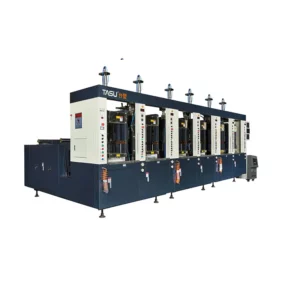
TASU provides rubber injection molding machine solutions for automotive rubber parts and other industrial rubber products.
Why Rubber Injection Molding Is Used in Auto Parts
Automotive rubber parts must withstand heat, oil, vibration, pressure, weather and repeated movement. Injection molding helps manufacturers produce these parts with better control over material distribution, curing and dimensions.
Benefits include:
- More stable part quality
- Better filling of complex cavities
- Shorter cycle time than some traditional methods
- Lower material waste
- Suitable for multi-cavity molds
- Good repeatability for mass production
Common Automotive Rubber Products
Rubber injection molding machines can produce many auto parts:
| Product Type | Common Materials | Key Requirement |
|---|---|---|
| Seals | EPDM, NBR, silicone rubber | Dimensional stability |
| Gaskets | NBR, EPDM, FKM | Compression resistance |
| Bushings | Natural rubber, NR blends | Vibration performance |
| Dust covers | EPDM, SBR | Flexibility and durability |
| Rubber bonded metal parts | NR, NBR, EPDM | Bonding strength |
| Vibration dampers | NR, SBR | Fatigue resistance |
The machine should be selected according to the product size, rubber compound and mold structure.
Key Machine Requirements for Auto Parts
Accurate Injection Control
Automotive parts often have strict tolerances. Stable injection pressure and volume help ensure complete filling and consistent part weight.
Reliable Temperature Control
Rubber curing must be controlled carefully. Poor temperature control can cause undercure, overcure, bubbles, surface defects or unstable mechanical properties.
Proper Clamping Force
Clamping force must prevent flash during injection. Flash is especially problematic for seals and gaskets because it can affect assembly and sealing performance.
Mold Compatibility
Auto parts may use multi-cavity molds or insert molding. The machine must match the mold size, platen structure and ejection method.
Automation Options
For high-volume auto parts, automation can reduce labor and improve repeatability. Automatic product removal, mold sliding and process monitoring can be valuable.
Vertical or Horizontal Machine?
Both vertical and horizontal rubber injection molding machines can be used for auto parts.
Vertical machines are often suitable for:
- Insert molding
- Rubber bonded metal parts
- Small and medium components
- Flexible production
Horizontal machines are often suitable for:
- Automated production lines
- Conveyor-based product handling
- Certain larger molded parts
- Continuous manufacturing layouts
The best structure depends on the product design and factory workflow.
Material Considerations
Automotive rubber parts use different compounds depending on performance requirements.
EPDM is common for weather resistance and sealing. NBR is often used for oil resistance. Natural rubber and SBR are used for vibration and elastic components. FKM may be used for high-temperature and chemical resistance applications.
The machine supplier should understand the material’s flow, curing behavior and processing window.
How to Improve Auto Part Quality
To produce stable automotive rubber parts, manufacturers should control:
- Rubber compound preparation
- Mold temperature
- Injection pressure and speed
- Venting design
- Curing time
- Mold cleaning
- Product inspection
- Preventive maintenance
Machine accuracy is important, but mold quality and process discipline are equally critical.
FAQ
Can rubber injection molding machines produce automotive seals?
Yes. They can produce seals, gaskets and other precision rubber parts if the machine and mold are properly selected.
Which rubber material is best for auto parts?
It depends on the application. EPDM, NBR, natural rubber, SBR and FKM are common choices for different automotive environments.
Is automation necessary for automotive rubber parts?
Automation is not always necessary, but it is useful for high-volume production and strict quality consistency.
What causes flash in automotive rubber molding?
Common causes include insufficient clamping force, poor mold fit, excessive injection pressure or worn mold surfaces.