


Styrene Butadiene Rubber (SBR) stands out as a versatile synthetic rubber, celebrated for its balanced material properties that make it a staple across multiple industries. From automotive manufacturing to consumer goods production, understanding its characteristics, uses in rubber molding, and comparative advantages is key to leveraging its potential effectively.
1. Core Material Properties of SBR Rubber
The utility of SBR stems from its distinct set of material properties, which balance performance and practicality:
-
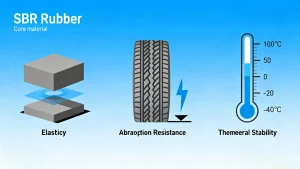
Elasticity: SBR exhibits high elasticity, enabling it to return to its original shape after deformation. This trait is critical for applications like tires and seals, where the material must absorb impact or pressure repeatedly without permanent damage. For instance, tire treads made with SBR can withstand road friction and bounce back from compression, ensuring long-term functionality.
-
Durability & Abrasion Resistance: SBR is highly durable, particularly against abrasive forces. This makes it ideal for products subjected to constant wear, such as conveyor belts, gaskets, and footwear soles. Unlike some weaker rubbers, SBR maintains its structure even under consistent mechanical stress, extending the lifespan of end products.
-
Thermal Stability: SBR performs reliably within a moderate temperature range of -40°C to 100°C (-40°F to 212°F). While it cannot withstand extreme heat like EPDM or fluorosilicone, it suffices for most everyday applications, from automotive weatherstripping to industrial hoses used in standard factory conditions.
-
Chemical Resistance: SBR resists mild chemicals and water effectively, but it is vulnerable to oils, fuels, and strong solvents. This limits its use in fuel-handling systems but makes it suitable for environments with low chemical exposure, such as household appliance gaskets.
-
Electrical Insulation: As an excellent electrical insulator, SBR is valued in electronics and automotive industries. It prevents electrical interference in components like protective housings, ensuring safety and performance in devices ranging from wiring insulation to battery casings.
-
Ease of Processing: SBR’s greatest practical advantage lies in its processability. It can be shaped via injection molding, compression molding, or extrusion with minimal effort, allowing manufacturers to produce custom components efficiently—from intricate gaskets to large rubber mats.
2. Key Applications: Styrene Butadiene Rubber Uses
SBR’s properties make it indispensable across diverse sectors, with its uses tailored to leverage its strengths:
Automotive Industry
SBR is most renowned for its role in tire production. Mixed with natural rubber (NR) and polybutadiene, it enhances tire durability, traction, and wear resistance—critical for tread compounds that endure constant road friction. Beyond tires, SBR is used in gaskets, seals, and bushings, where its compression resistance and low-temperature flexibility ensure tight seals around doors and windows (weatherstripping).
Footwear
In footwear manufacturing, SBR is a cost-effective choice for soles and outsoles. Its abrasion resistance and elasticity make it suitable for sports shoes and everyday footwear, as it withstands rough outdoor use while remaining flexible. Its easy processability also allows for detailed designs, improving both the aesthetics and grip of shoe soles.
Industrial Components
SBR is widely used in industrial seals, gaskets, belts, and hoses. Seals and gaskets made from SBR prevent leakage of gases and fluids in machinery, thanks to their compression set resistance. Conveyor belts and v-belts rely on SBR’s strength and wear resistance to handle heavy loads and constant friction in factories. However, its vulnerability to ozone and UV means it is often blended with additives for outdoor use.
Adhesives & Coatings
SBR-based adhesives are popular in automotive, construction, and electronics industries, as they offer strong bonding to metals, plastics, and paper. In coatings, SBR provides water resistance and low-temperature flexibility, protecting surfaces from moisture and physical wear—for example, in protective coatings for industrial equipment.
Consumer Goods
Everyday products like rubber mats (yoga mats, non-slip mats), sports equipment, and toy components use SBR for its durability and flexibility. It also enhances the longevity of home appliances, such as refrigerators and washing machines, by serving as gaskets that maintain airtight or watertight seals.
3. SBR in Rubber Molding: Manufacturing Processes
Rubber molding is the primary method for shaping SBR into functional components, and SBR’s processability makes it a top choice for manufacturers. Three key molding techniques are commonly used:
-
Injection Molding: Heated SBR is injected under high pressure into a mold cavity. This method is ideal for high-volume, precision parts like automotive seals and small gaskets, as it produces consistent, detailed components quickly.
-
Compression Molding: SBR is placed directly into a mold, then shaped using heat and pressure. This technique suits larger, bulkier products such as rubber mats, bumpers, and washers, where precision is less critical than size and durability.
-
Transfer Molding: A hybrid of injection and compression molding, this process uses a plunger to transfer preheated SBR into a mold. It is used for intricate parts with complex geometries, such as custom industrial gaskets, where detailed shapes are required.
SBR’s advantages in molding include low friction during processing (reducing mold wear), excellent flow properties (enabling intricate designs), and cost-effectiveness for mass production. Manufacturers often modify SBR with additives like carbon black or silica to enhance specific properties—e.g., adding silica to boost heat resistance for automotive components.
4. SBR vs. Other Rubber Materials
Choosing the right rubber depends on application needs, and SBR’s performance varies when compared to alternatives like natural rubber (NR), nitrile rubber (NBR), and EPDM:
| Rubber Type | Key Advantage Over SBR | Key Disadvantage vs. SBR | Ideal Applications |
|---|---|---|---|
| Natural Rubber (NR) | Higher tensile strength and resilience | More expensive; poor oil/ozone resistance | Rubber bands, vibration isolators |
| Nitrile Rubber (NBR) | Superior oil/fuel resistance; better heat tolerance | Less flexible; higher cost | Fuel hoses, oil seals |
| EPDM | Excellent UV/ozone resistance; wider temperature range | Poor oil resistance; harder to process | Outdoor weatherstripping, roofing |
| Polyurethane (PU) | Greater abrasion resistance and strength | Less elastic; more costly | Heavy machinery parts, robotic components |
Conclusion
Styrene Butadiene Rubber (SBR) remains a vital material in modern manufacturing, thanks to its balanced sbr rubber material properties—elasticity, durability, and processability—that drive its diverse styrene butadiene rubber uses across automotive, industrial, and consumer sectors. Its compatibility with rubber molding processes further enhances its appeal, allowing for efficient production of custom components. While SBR has limitations (e.g., poor oil/UV resistance), ongoing innovations in bio-based variants and recycling are addressing these gaps, ensuring its relevance in a more sustainable future. For manufacturers, understanding SBR’s strengths and comparisons to other rubbers is essential for selecting the optimal material for their applications.