


1. Introduction
What is Plastic Injection Molding?
Plastic injection molding is a core manufacturing technique where molten plastic is forced into a custom mold, allowing it to cool and solidify into precise, uniform shapes. This method is a cornerstone of mass production, used to create an extensive range of products—from small automotive components and consumer electronics casings to medical devices and household items—thanks to its ability to replicate complex designs consistently.
Why TPE and TPU are Popular in Injection Molding
Thermoplastic elastomers (TPE) and thermoplastic polyurethanes (TPU) stand out in the injection molding industry for their unique blend of flexibility, durability, and ease of processing. Unlike rigid plastics, both materials offer rubber-like elasticity while retaining the recyclability and moldability of thermoplastics. This versatility lets manufacturers produce high-quality parts that meet strict performance standards across industries: TPE excels in applications needing softness, while TPU delivers ruggedness for demanding use cases. Together, they cover a wide spectrum of needs in automotive, medical, and consumer goods sectors.
2. What is TPE (Thermoplastic Elastomer)?
TPE Material Characteristics
Thermoplastic elastomers (TPE) bridge the gap between rubber and traditional thermoplastics. They offer the softness, flexibility, and elasticity of rubber—making them ideal for products requiring a comfortable, tactile feel—while being recyclable and processable with standard thermoplastic equipment. A key trait of TPE is its thermoplastic nature: it softens when heated (allowing easy molding) and hardens when cooled, without losing its elastic properties over repeated cycles. This makes it highly adaptable for diverse manufacturing needs.
Common Applications of TPE
TPE’s combination of softness and processability makes it ubiquitous in daily and industrial products. In automotive, it’s used for door seals, dashboard grips, and wire insulation. The medical industry relies on it for non-toxic, flexible parts like syringe plungers and catheter components. Consumer goods also heavily use TPE: think soft-touch handles on kitchen utensils, chewable toy parts, footwear insoles, and baby bottle nipples. Its ability to mimic rubber without the complexity of rubber molding (e.g., no vulcanization) makes it a top choice for low-stress, comfort-focused applications.
3. What is TPU (Thermoplastic Polyurethane)?
TPU Material Characteristics
Thermoplastic polyurethane (TPU) is a high-performance subset of thermoplastic elastomers, defined by its urethane-based polymer structure. It stands out for exceptional durability, abrasion resistance, and toughness—outperforming many TPEs in high-stress environments. TPU also offers excellent resistance to oils, greases, and most solvents, and its hardness can be tailored (from flexible to semi-rigid) via chemical formulation. Unlike some TPEs, it maintains mechanical properties at elevated temperatures, making it suitable for harsh operating conditions.
Common Applications of TPU
TPU’s ruggedness makes it ideal for applications where durability is non-negotiable. In footwear, it’s used for running shoe midsoles and hiking boot toes—areas prone to wear. The automotive sector uses it for fuel lines, suspension bushings, and protective trim, as it withstands mechanical stress and oil exposure. Electronics rely on TPU for shock-absorbing phone cases and cable jackets, while industrial uses include hydraulic hoses, conveyor belts, and flexible films (e.g., for waterproof packaging). It’s also common in medical devices like orthopedic braces, where long-term durability and biocompatibility are critical.
4. Key Differences Between TPE and TPU
Chemical Composition Comparison
The fundamental distinction lies in their chemical structures: TPE is a broad category encompassing multiple elastomer types (e.g., styrenic block copolymers, olefinic elastomers), while TPU is a specific thermoplastic elastomer made from urethane polymers. This structural difference directly influences their performance, processability, and suitability for applications—TPU’s urethane backbone, for example, contributes to its superior strength and chemical resistance, while TPE’s varied formulations prioritize flexibility and cost.
Physical Properties Comparison
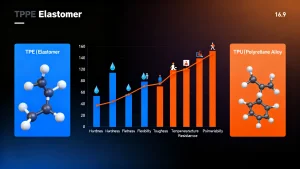
Key Differences Between TPE and TPU
Physical Properties Comparison
| Property | TPE | TPU |
|---|---|---|
| Hardness | Lower (typically 30–90 Shore A), softer | Higher (50 Shore A to 85 Shore D), stronger/more rigid |
| Flexibility | Exceptionally flexible, rubber-like | Flexible but more rigid; maintains shape under stress |
| Temperature Resistance | Limited (degrades above ~120°C) | Superior (maintains properties up to 150–180°C) |
| Durability | Suitable for low-stress use; lower abrasion resistance | Highly durable; excels in high-stress environments with strong abrasion/impact resistance |
Cost Differences
TPE is generally more cost-effective than TPU, with lower raw material and processing costs. TPU’s higher price reflects its premium properties—superior durability, temperature resistance, and chemical stability. For manufacturers, the choice often comes down to balancing needs: TPE is ideal for high-volume, low-cost applications where softness is key (e.g., toy parts), while TPU is worth the investment for high-performance parts (e.g., industrial hoses) where failure due to wear could be costly.
5. Injection Molding Process for TPE vs TPU
TPU Injection Molding Process
TPU injection molding demands precision to unlock its full performance potential. The material requires higher processing temperatures—typically 230°C to 270°C—due to its higher viscosity. A specialized TPU injection molding machine is often necessary, as it must handle TPU’s unique flow behavior and maintain consistent heat distribution. TPU has excellent flow properties for intricate designs (e.g., detailed electronics components), but it needs controlled cooling: slower cooling rates prevent shrinkage and ensure uniform solidification, which is critical for retaining its mechanical strength.
TPE Injection Molding Process
TPE injection molding aligns closely with traditional thermoplastic molding, making it easier to integrate into existing production lines. TPEs process at lower temperatures (180°C to 230°C) and flow smoothly into molds, reducing the risk of incomplete filling. While TPE’s flexibility means less precision is needed than with TPU in some cases, careful temperature control remains essential: overheating can cause warping, while underheating leads to poor mold adhesion. Cooling is faster with TPE, shortening cycle times—an advantage for high-volume production.
Key Differences in Molding Conditions
| Molding Condition | TPE Injection Molding | TPU Injection Molding |
|---|---|---|
| Molding Temperatures | Lower (180°C–230°C) | Higher (230°C–270°C) |
| Cooling Rates | Faster; solidifies quickly | Slower; controlled cooling prevents shrinkage |
| Material Flow | Smooth, predictable flow | Complex flow behavior; needs precise control |
| Precision Needs | Lower (suitable for less detailed parts) | Higher (critical for complex, high-performance parts) |
6. TPU vs TPE Injection Molding Machines
TPU Injection Molding Machines
TPU requires specialized TPU injection molding machines designed to handle its high-temperature processing and viscous nature. These machines feature advanced temperature regulation systems (to maintain 230°C–270°C consistently) and high-pressure injection units (to ensure TPU flows into intricate molds evenly). They also include controlled cooling systems to manage TPU’s slower solidification. Additional features—like corrosion-resistant barrels (to handle TPU’s chemical composition)—may be necessary for long-term use. While these machines have higher upfront costs, they are essential for producing high-quality TPU parts.
TPE Injection Molding Machines
TPE injection molding can use standard thermoplastic injection molding machines, reducing equipment costs. These machines need precise temperature controls (to avoid TPE degradation) but do not require the high-pressure or specialized cooling systems needed for TPU. Many manufacturers can adapt existing machines for TPE, making it a cost-effective choice for high-volume production. That said, basic temperature and pressure monitoring remains critical to avoid defects like warping or incomplete filling.
Choosing the Right Machine for Your Needs
The choice between TPE and TPU injection molding machines depends on three factors: product complexity, production volume, and material requirements. For simple parts (e.g., soft grips) and high-volume runs, TPE machines are ideal—they’re affordable, easy to integrate, and offer fast cycle times. For complex, high-performance parts (e.g., industrial seals), TPU machines are necessary—their specialized features ensure TPU retains its durability and precision. Manufacturers should also consider long-term costs: TPU machines have higher upfront costs but reduce waste for high-value parts, while TPE machines lower initial investment but may not be suitable for demanding applications.
7. Pros and Cons of TPE vs TPU in Injection Molding
To simplify comparison, the table below outlines the key advantages and disadvantages of TPE and TPU for injection molding:
| Aspect | TPE Injection Molding | TPU Injection Molding |
|---|---|---|
| Advantages | 1. Cost-effective 2. Easy to process with standard machines 3. Fast cooling & short cycle times 4. Excellent softness & rubber-like feel 5. No specialized equipment needed |
1. Superior durability & abrasion resistance 2. Excellent temperature resistance 3. Strong chemical resistance 4. Versatile, customizable hardness 5. Ideal for high-stress applications |
| Disadvantages | 1. Limited durability 2. Low temperature resistance 3. Lower abrasion/impact resistance 4. Unsuitable for harsh chemicals |
1. Higher cost (materials & machines) 2. Complex processing 3. Slower cooling & longer cycles 4. Needs specialized machines 5. Higher risk of defects without proper control |

8. Applications and Use Cases
Industries Using TPE Injection Molding
TPE’s softness, cost-effectiveness, and ease of processing make it a staple in:
- Automotive: Door seals, dashboard soft-touch surfaces, wire insulation, and steering wheel grips.
- Consumer Goods: Kitchen utensil handles, toy parts, baby bottle nipples, and footwear insoles.
- Medical: Syringe plungers, catheter components, and flexible bandages (thanks to biocompatibility).
- Packaging: Flexible lids, protective foam inserts, and sealants (balances flexibility and cost).
Industries Using TPU Injection Molding
TPU’s durability and high-performance properties make it essential for:
- Footwear: Running shoe midsoles, hiking boot toe caps, and sandal straps (resists wear and impact).
- Automotive: Fuel lines, suspension bushings, and protective trim (withstands oil and mechanical stress).
- Electronics: Shock-absorbing phone cases, cable jackets, and laptop hinge covers (protects against drops).
- Industrial: Hydraulic hoses, conveyor belts, and protective coatings (resists abrasion and chemicals).
- Medical: Orthopedic braces, surgical instrument handles, and dialysis machine components (durable and biocompatible).
9. Summary
TPE and TPU are both valuable materials in injection molding, but their unique properties make them suited for distinct applications. TPE excels in cost-effectiveness, softness, and ease of processing—making it ideal for high-volume, low-stress products like consumer goods and basic automotive parts. TPU, by contrast, delivers superior durability, temperature resistance, and chemical stability—justifying its higher cost for high-performance applications like industrial hoses, electronics protection, and heavy-duty automotive components.
The choice between TPE injection molding and TPU injection molding hinges on balancing needs: for soft, affordable parts, TPE and standard machines are the way to go; for rugged, high-stress parts, TPU and specialized TPU injection molding machines are necessary. Understanding the differences in material properties, molding processes, and equipment requirements ensures manufacturers select the right solution to meet performance goals and cost constraints. Ultimately, both materials play critical roles in expanding the capabilities of plastic injection molding across industries.