


In the field of rubber and plastic product manufacturing, transfer molding stands as a pivotal process bridging traditional compression molding and modern injection molding. It holds an irreplaceable position particularly in thermosetting material forming and precision component encapsulation. From automotive seals to chip packaging, this technology leverages its characteristics of “precision shaping and gentle mold filling” to demonstrate unique advantages in both rubber transfer molding and plastic processing. This article systematically breaks down the principles, processes, core features of transfer molding, and compares it with related technologies such as Rubber injection molding, providing comprehensive technical references for industry practitioners.
Transfer molding is a manufacturing process primarily applied to thermosetting plastics and rubber. As a representative of closed-mold molding technology, it integrates the core advantages of compression molding and injection molding, achieving a balance between “shaping precision” and “processing efficiency” in the production of complex components. Among them, rubber transfer molding, tailored for rubber materials, further demonstrates its superiority as a preferred process for rubber products with inserts by precisely controlling the flow of elastomeric materials.
In layman’s terms, the core logic of this process lies in “zoned temperature control and pressure-driven mass transfer”: raw materials are first heated in an independent heating chamber (called a “pot”) until they become soft and pliable. Subsequently, a hydraulic plunger applies pressure to force the material through small channels (called “sprue” or “runner”) into a closed, heated mold cavity, where it finally cures (hardens) to form the finished product as designed. This “preheating followed by mass transfer” mode is distinctly different from the method by which a Rubber injection molding machine directly injects molten material into the mold, also making it more advantageous in the encapsulation of sensitive components.
Core Characteristics of Transfer Molding
The technical characteristics of transfer molding are determined by its mechanism of “closed-mold mass transfer and preheating plasticization”, mainly reflected in the following five aspects:
-
Closed-Mold Molding: The mold is fully closed before material injection, which is completely different from the compression molding mode of “feeding first and closing the mold later”. This effectively reduces flash and improves dimensional accuracy.
-
Material Preheating: Raw materials usually exist in the form of prefabricated “charges” or “pellets”, and undergo preheating and plasticization in a dedicated transfer pot. This lays the foundation for smooth subsequent mold filling, which is also the core hallmark of pot transfer molding.
-
Plunger Pressurization: Stable pressure is provided by a hydraulic plunger to ensure that the plasticized material overcomes runner resistance and completely fills the complex cavity of the mold, making it particularly suitable for components with fine structures.
-
Compatibility with Thermosetting Materials: The process is almost exclusively designed for thermosetting materials—materials such as epoxy, phenolic, and silicone undergo irreversible chemical changes when heated, and cannot be remelted after curing. The temperature control system of transfer molding perfectly matches this characteristic.
-
Adaptability to Rubber Materials: By optimizing the pot temperature and plunger pressure, rubber transfer molding solves the problem of poor fluidity of elastomeric materials, enabling efficient production of rubber seals, diaphragms, and other products with metal inserts.
Step-by-Step Process Flow of Transfer Molding
The production process of transfer molding must strictly follow the sequence of “preparation – feeding – transfer – curing – demolding”, and the parameter control of each link directly affects product quality:
-
Mold Preparation: The moving and fixed halves of the mold are clamped and heated to a set temperature (usually controlled between 120-180℃ according to material properties). If the product needs to contain inserts such as metal pins and electronic components, they must be accurately placed and fixed in the mold cavity at this stage to avoid displacement during mold filling.
-
Material Loading: A quantitative amount of raw materials (charges or pellets) is weighed according to the product weight and runner loss, and placed into the transfer pot located above the mold. It is ensured that the material quantity not only meets the molding requirements but also avoids excessive waste.
-
Pressure Transfer: The hydraulic plunger descends and presses into the pot at a preset speed (usually 5-15mm/s). Under pressure (generally 10-30MPa), the material is further heated and softened to generate flow, and quickly fills the closed mold cavity through the runner system until the entire cavity is completely filled.
-
Isothermal Curing: The material maintains pressure and temperature in the closed mold for a certain period (the curing time ranges from tens of seconds to several minutes, depending on the product thickness and material). During this process, the thermosetting material undergoes a cross-linking reaction and gradually hardens into shape.
-
Mold Opening and Demolding: After curing is completed, the mold opens, and the ejector pins push out the finished components. At the same time, the excess material cured in the pot and runner (called “cull” or “flash”) is taken out together with the product, and can usually be easily separated from the product.
Core Differences Between Transfer Molding and Related Processes
To understand the positioning of transfer molding more clearly, the following compares it with processes such as compression molding and Rubber injection molding from key dimensions, with particular emphasis on the process differences achieved by a Rubber injection molding machine:
|
Comparison Dimension
|
Transfer Molding (Including Rubber Transfer Molding)
|
Compression Molding
|
Rubber Injection Molding
|
|---|---|---|---|
|
Mold State
|
Fully closed before material transfer
|
Mold open during material loading; clamped after feeding
|
Mold closed before injection, consistent with transfer molding
|
|
Material Processing Method
|
Preheated and plasticized in the pot, a core feature of pot transfer molding
|
Cold or warm material directly added to the mold cavity
|
Melted and plasticized in the barrel of the Rubber injection molding machine, conveyed by a screw
|
|
Material Feeding Method
|
Plunger pressurization forces material through the runner
|
Clamping pressure squeezes material to fill the cavity
|
High-pressure injection by the screw of the Rubber injection molding machine, with faster flow rate
|
|
Suitable Products
|
Rubber and plastic products with complex structures and inserts, electronic packaging components
|
Large-sized products with simple structures, such as rubber gaskets
|
High-volume rubber products with medium complexity, such as O-rings
|
|
Dimensional Accuracy
|
High, with a tolerance of up to ±0.05mm
|
Relatively low, easily affected by flash
|
Very high, with better temperature control accuracy of the Rubber injection molding machine
|
|
Flash Condition
|
Minimal, only slight traces on the parting surface
|
Abundant, requiring subsequent trimming
|
Minimal, comparable to transfer molding
|
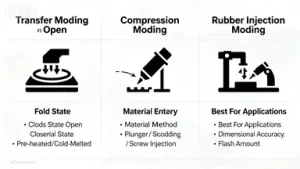
Advantages and Limitations of Transfer Molding
1. Core Advantages
-
Strong Capability for Complex Component Molding: Under high pressure, the material has excellent fluidity, which can perfectly replicate the fine structures of the mold and easily handle complex designs such as deep cavities, side holes, and undercuts, making it particularly suitable for precision electronic components.
-
Outstanding Precision Encapsulation Effect: The mold filling process is stable with little turbulence, which can effectively protect the wire bonds of fragile components such as semiconductor chips and sensors. It is one of the preferred processes for electronic encapsulation. This advantage is also reflected in rubber transfer molding as gentle wrapping of inserts.
-
Good Dimensional Stability: Closed-mold molding reduces the uncertainty of material shrinkage, resulting in products with consistent dimensions and strict tolerance control, without the need for extensive subsequent processing.
-
Convenient Use of Inserts: The closed mold cavity provides a stable positioning environment for metal inserts, enabling direct integrated molding of “rubber/plastic-metal” and improving product reliability.
-
Less Flash Loss: Compared with compression molding, the flash amount of transfer molding is significantly reduced, which reduces raw material waste and lowers the labor cost of subsequent trimming.
2. Main Limitations
-
High Mold Cost: The mold needs to integrate special structures such as pots and runners, resulting in high design and processing difficulty and much higher initial investment than compression molding molds.
-
Inevitable Material Waste: The cull cured in the pot and runner is thermosetting waste, which cannot be recycled and reused like the runner material of Rubber injection molding, increasing material costs.
-
Prone to Bubble Defects: If the pot is poorly ventilated or the mold filling speed is too fast, air is easily trapped in the cavity, forming internal pores and affecting product strength.
-
Relatively Long Production Cycle: The curing process of thermosetting materials takes a long time, and the overall cycle is usually 30%-50% longer than that of Rubber injection molding, making it unsuitable for ultra-large-scale mass production.
Typical Application Scenarios of Transfer Molding
With the dual advantages of “precision shaping and gentle mold filling”, transfer molding plays an irreplaceable role in many high-tech fields, among which rubber transfer molding and electronic encapsulation are the two core application directions:
1. Electronic Information Field
This is the most important application scenario of transfer molding, especially indispensable in chip packaging. It includes the manufacturing of black epoxy packaging shells for silicon chips, semiconductor packaging components such as DIP (Dual In-line Package), QFP (Quad Flat Package), and BGA (Ball Grid Array); it is also used for potting of sensors and coils, as well as the molding of insulating shells for switches, connectors, circuit breakers and other electrical components.
2. Rubber Product Field
Rubber transfer molding is specifically designed for elastomeric materials. It is used to produce rubber diaphragms, seals, gaskets and other products with metal inserts, solving the problems of poor rubber fluidity and easy displacement of inserts in ordinary processes, and is widely used in automotive, hydraulic systems and other fields.
3. Daily Necessities and Home Appliances Field
It is suitable for components that need to withstand high temperatures, such as pot handles, oven knobs, and electrical housings inside home appliances. These components require materials to have good heat resistance and insulation, and the thermosetting materials used in transfer molding just meet the requirements.
Summary
Transfer molding, especially pot transfer molding centered on pot transfer and rubber transfer molding for elastomers, is a molding technology that balances precision and practicality. Through its unique process of “pot preheating – plunger mass transfer – closed-mold curing”, it perfectly matches the characteristics of thermosetting materials and demonstrates advantages far exceeding compression molding in complex component molding and precision encapsulation. Although it is slightly inferior to processes such as Rubber injection molding in terms of cost and efficiency, transfer molding remains an irreplaceable core technology in niche fields such as electronic encapsulation and rubber/plastic products with inserts, providing solid support for the high-quality development of modern manufacturing.