


What is Thermoplastic Rubber (TPR)?
Thermoplastic Rubber (TPR) is a hybrid material blending rubber and plastic, combining the most advantageous properties of both. It boasts the flexibility characteristic of rubber while offering the processability of plastic, making it highly suitable for injection molding. Thanks to its excellent elasticity, soft tactile feel, and ability to be shaped into complex forms, TPR finds application in a diverse range of products across multiple sectors.
Why Opt for TPR in Injection Molding?
TPR merges the inherent traits of rubber—such as flexibility and resilience—with the convenience of thermoplastic processing. This unique combination endows it with outstanding flexibility, durability, and impact resistance. Moreover, TPR is highly customisable: manufacturers can adjust the ratio of rubber to plastic in its composition to produce products with varying hardness levels. These attributes have made TPR a favoured material for manufacturing items like seals, grips, and soft-touch components.
Understanding the TPR Injection Molding Process
Fundamentals of Injection Molding
Injection molding is a widely adopted manufacturing method where plastic or rubber materials are injected into a mold under high pressure to form solid parts. It excels in producing high volumes of complex-shaped products with exceptional precision and consistency.
For TPR, injection molding leverages the material’s rubber-like flexibility and plastic-like processability. Molten TPR is injected into a mold, where it solidifies to take on the shape of the mold cavity. This process is not only efficient but also capable of manufacturing parts with tight dimensional tolerances.
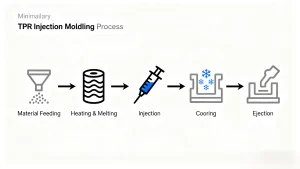
The standard injection molding process comprises the following key steps:
- Material Feeding: TPR pellets are loaded into the machine’s hopper and conveyed into the injection molding system.
- Heating and Melting: Inside the machine’s barrel, the TPR pellets are heated until they transform into a molten state.
- Injection: The molten TPR is injected into the mold cavity under high pressure.
- Cooling: The molten material cools and solidifies within the mold.
- Ejection: Once fully cooled, the molded part is removed from the mold and prepared for further processing or quality inspection.
How TPR Injection Molding Works
The tpr injection molding process commences with feeding TPR pellets into the hopper of the injection molding machine. These pellets then enter the machine’s barrel, where they are heated to a specific temperature (usually between 180°C and 230°C) to become molten. The molten TPR is subsequently injected into a pre-designed mold at high pressure, ensuring it completely fills the cavity and replicates the mold’s shape accurately.
After injection, the molded part is cooled using either air-cooled or water-cooled molds. Cooling time is critical: it ensures the material solidifies uniformly, which is essential for achieving precise dimensional accuracy and a high-quality surface finish.
Once sufficient cooling has occurred, the mold opens, and the part is ejected. The part is then ready for post-processing—such as trimming excess material—or rigorous quality control checks.
TPR Injection Molding Temperature
Temperature control is a pivotal factor in tpr injection molding temperature management, as it directly impacts both the flowability of the material and the final properties of the molded part.
Melt Temperature
The melt temperature for TPR typically ranges from 180°C to 230°C, with variations depending on the specific grade of TPR. A higher melt temperature enhances the material’s flowability, reducing the risk of defects like incomplete filling (known as “short shots”) in molds with complex geometries.
Mold Temperature
Mold temperature for TPR injection molding is generally maintained between 30°C and 80°C. A lower mold temperature accelerates the cooling process, which is beneficial for high-volume production. In contrast, a higher mold temperature contributes to better surface quality and smoother finishes on the final product. The exact mold temperature is often adjusted based on the desired characteristics of the end part.
Cooling Time
Cooling time is influenced by two key factors: the thermal conductivity of the TPR material and the thickness of the molded part. Thinner parts naturally cool more quickly than thicker ones. Striking the right balance in cooling time is crucial to prevent issues such as warping or uneven shrinkage of the part.

Types of TPR Injection Molding Machines
What is a TPR Injection Molding Machine?
A tpr injection molding machine is specifically engineered to process thermoplastic rubbers like TPR. It is equipped with a specialized injection unit, heating system, and molding mechanism to accommodate TPR’s unique properties—its rubber-like flexibility paired with the processability of thermoplastics.
While these machines share core components with standard injection molding equipment, they feature specialized enhancements, including more precise temperature control systems and stronger injection pressure capabilities. These adaptations are necessary to handle the specific rheological (flow-related) properties of TPR.
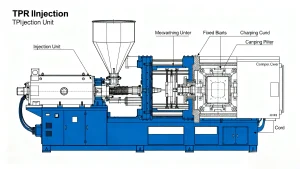
The key components of a tpr injection molding machine include:
- Injection Unit: Responsible for melting the TPR material and injecting it into the mold.
- Clamping Unit: Secures the two halves of the mold together during the injection and cooling phases.
- Mold: The cavity where molten TPR is injected and shaped into the final product.
Selecting the Right TPR Injection Molding Machine
Several factors must be considered when choosing a tpr injection molding machine to ensure optimal performance and product quality:
- Machine Size: The machine’s size should align with the dimensions and complexity of the product being manufactured. Larger or more intricate products demand machines with greater injection capacity and larger mold accommodation areas.
- Clamp Force: This refers to the pressure applied to keep the mold closed during injection. For flexible, elastic TPR, clamp force must be carefully selected to avoid over-compacting the material, which could distort the part or cause defects.
- Injection Pressure: TPR’s flexibility means it may require higher injection pressure to fill molds with intricate details or thin walls. It is essential to choose a machine that can deliver the required pressure while maintaining precision.
- Heating and Cooling Capabilities: TPR relies on precise heating and cooling control to maintain uniform temperatures throughout the molding process. Machines fitted with advanced temperature control systems help ensure consistent part quality and prevent defects like warping or uneven cooling.
Innovations in TPR Molding Machines
Recent advancements in TPR injection molding machines have focused primarily on boosting efficiency and enhancing part quality. Notable innovations include:
- Electric Injection Molding Machines: These offer superior control, higher accuracy, and greater energy efficiency compared to traditional hydraulic machines.
- Advanced Temperature Control: Modern machines feature more precise heating and cooling systems, reducing production cycle times and improving consistency across batches of parts.
- Multi-Cavity Molds: Contemporary machines are designed to work with multi-cavity molds, which increase production rates and lower per-unit costs by manufacturing multiple parts simultaneously in a single cycle.
Factors Influencing TPR Material Injection Molding
Material Properties
The unique characteristics of TPR—such as elasticity, soft-touch feel, and low density—make it ideal for injection molding, but they also shape the tpr material injection molding process:
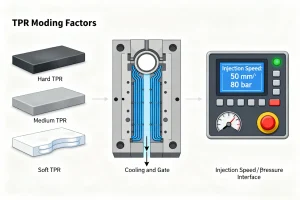
- Hardness: TPR’s hardness can be adjusted via formulation changes, which affects how it behaves during molding. Softer TPR grades often require more precise control over injection speed and pressure.
- Elasticity: The material’s elasticity impacts cooling time and the mold’s ability to maintain the part’s shape during solidification.
- Thermal Conductivity: TPR cools more slowly than standard plastics due to its thermal properties. This necessitates careful temperature management to avoid defects like warping or dimensional inconsistencies.
Mold Design Considerations
Mold design is critical to the success of tpr material injection molding. Key design considerations include:
- Gate Design: The gate (where molten TPR enters the mold) must be properly positioned and sized to ensure even material flow, minimising the risk of defects like short shots.
- Venting: Effective venting allows trapped air to escape from the mold cavity during injection, preventing air bubbles or pressure buildup that could distort the part.
- Cooling Channels: Mold cooling channels should be strategically designed to ensure uniform cooling of the part. Uneven cooling often leads to warping or surface imperfections.
Injection Speed and Pressure
Injection speed and pressure have a significant impact on the quality of the final product:
- Injection Speed: Higher speeds ensure the molten TPR fills the mold quickly and evenly, which is vital for complex shapes. However, excessively high speeds can cause defects such as flash (excess material seeping out of mold seams) or material degradation.
- Injection Pressure: Appropriate pressure ensures the mold is completely filled, capturing even intricate details. Insufficient pressure may result in short shots, while excessive pressure can lead to flash.
Applications of TPR Molding
Industries Utilising TPR Injection Molding
TPR’s unique properties—flexibility, durability, and ease of processing—make tpr molding invaluable across various industries:
- Automotive Industry: TPR is widely used for components requiring flexibility and durability, including heat-and chemical-resistant seals and gaskets, soft-touch bumper strips and interior grips, and robust hoses and tubing.
- Footwear Industry: TPR is a popular material for footwear soles, offering a balance of flexibility, durability, and comfort. It can be mass-produced efficiently, making it suitable for both casual and athletic shoes.
- Consumer Goods: The material is used for soft-touch handles on tools and kitchen utensils, keypads for remotes and phones, and grips for sporting equipment.
- Medical Industry: Biocompatible TPR grades are utilised for flexible medical tubing, airtight seals for medical devices, and ergonomic grips on surgical instruments.
- Electronics Industry: TPR serves as flexible insulation for wires and cables, and as shock-absorbent, soft-touch cases for smartphones and tablets.
Common Products Made from TPR Molding
tpr molding is used to manufacture a wide array of everyday products, including:
- Footwear soles (casual and athletic shoes)
- Tool handles and grips
- Seals and gaskets for automotive and industrial use
- Flexible toys and sporting goods (e.g., balls, protective padding)
- Shock-absorbent mobile phone cases
Summary
Thermoplastic Rubber (TPR) is a versatile hybrid material, and tpr molding leverages its rubber-plastic properties to produce high-quality, customisable parts. The tpr injection molding process—encompassing material feeding, heating, injection, cooling, and ejection—relies heavily on precise tpr injection molding temperature control (180°C–230°C for melt, 30°C–80°C for molds) to ensure material flow and avoid defects like warping. Specialised tpr injection molding machines, with tailored injection, clamping, and temperature control systems, are essential for consistent production, and innovations like electric machines further enhance efficiency. Factors such as TPR’s material properties (hardness, elasticity), mold design (gating, venting), and injection parameters directly influence the success of tpr material injection molding. Ultimately, TPR injection molding caters to diverse industries—from automotive to medical—proving its role as a key manufacturing solution for flexible, durable, and user-friendly products.