


1. An Overview of Injection Molding and Materials
What is Injection Molding?
Injection molding is a foundational manufacturing process for mass-producing parts. It works by heating a material until it’s molten and then injecting it under high pressure into a precision mold cavity. After cooling and solidifying, the part is ejected, resulting in a product that can range from simple to highly complex geometries.
The strength of this process lies in its ability to produce high volumes of parts with exceptional repeatability, tight tolerances, and minimal finishing requirements. It’s the go-to method for creating everything from tiny electronic components to large automotive body panels.
Key Materials in Injection Molding
Selecting the right material is critical, as it determines the final product’s mechanical properties, appearance, and performance. While thermoplastics are the most common, the range of usable materials is vast.
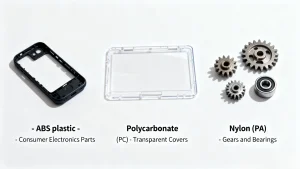
- ABS Plastic: Valued for its toughness and impact resistance, ABS is a staple in consumer electronics, automotive interiors, and household appliances.
- Polycarbonate (PC): Known for its high strength, clarity, and heat resistance, PC is often specified for protective glazing, optical lenses, and transparent covers.
- Nylon (PA): This material offers an excellent balance of strength, wear resistance, and low friction, making it ideal for mechanical components like gears and bearings.
Beyond rigid plastics, materials requiring flexibility and durability are also widely used. This is where rubber injection molding and specialized elastomers come into play, perfect for seals, gaskets, and soft-touch components.
2. Other Plastic Forming Processes
While injection molding is incredibly versatile, other forming methods are better suited for specific product types.
- Extrusion Molding: This process is for creating continuous, uniform profiles. Molten material is forced through a die to make products like pipes, tubing, and sheet stock. It’s distinct from injection molding as it produces long, continuous shapes rather than discrete, complex parts.
- Compression Molding: Often used for larger, relatively simpler parts and thermoset materials, this method involves placing a charge of material into a heated mold and closing it under pressure. It’s commonly used for automotive composites and large rubber parts but typically offers lower precision than injection molding.
- Rotational Molding: Ideal for large, hollow, and seamless products like tanks and buoys, rotational molding uses heat and biaxial rotation to coat the inside of a mold. The trade-off is lower dimensional accuracy compared to injection molding.
- Blow Molding: This is the primary method for manufacturing hollow objects like bottles and containers. It involves inflating a heated plastic parison inside a mold, which is a fundamentally different approach from the solid-fill nature of injection molding.
3. Rubber and Elastomers in Molding
For applications demanding elasticity, resilience, and performance under extreme conditions, rubber and elastomers are the materials of choice.
Rubber Injection Molding
Rubber injection molding is a high-volume process where uncured rubber is injected into a mold and vulcanized (cured) under heat and pressure. A specialized rubber injection molding machine is designed to handle the unique flow and curing characteristics of rubber compounds.
- Silicone Rubber: Offers superb heat resistance, chemical stability, and biocompatibility, making it essential for medical and food-grade applications.
- Nitrile Rubber (NBR): Prized for its excellent resistance to oils and fuels, it’s commonly used for seals and gaskets in automotive and industrial settings.
- Neoprene Rubber: A good all-purpose elastomer with strong weather and ozone resistance.
Thermoplastic Elastomers (TPE & TPU)
TPEs bridge the gap between plastics and rubbers. They can be melted and re-processed like plastics but exhibit rubber-like flexibility.
- TPU Injection Molding: TPU injection molding is a subset of TPEs, focusing on Thermoplastic Polyurethane. TPU is renowned for its exceptional abrasion resistance, toughness, and high elasticity. It’s widely used in products like smartphone cases, athletic shoe soles, industrial hoses, and automotive parts. The key advantage of TPU injection molding is that it can be processed on a standard plastic injection molding machine, offering the performance of rubber with the processing efficiency of plastic.
4. Metal Injection Molding (MIM)
Metal Injection Molding (MIM) merges the design flexibility of plastic injection molding with the strength and performance of metal. Fine metal powders are mixed with a polymer binder to create a feedstock that is injected into a mold. The “green” part is then debound and sintered to create a high-density, complex metal component. MIM is ideal for small, intricate parts made from stainless steel, titanium, or other alloys used in medical, aerospace, and firearms industries.
5. Common Applications
- Automotive: From bumpers and dashboards (plastics) to seals and hoses (rubber injection molding), these materials are essential for lightweight and durable vehicles.
- Medical: The industry relies on medical-grade plastics, silicones (from rubber injection molding), and MIM parts for devices that require precision, biocompatibility, and sterility.
- Consumer Products: The casings on your electronics, the components of your appliances, and even the soles of your shoes (often via TPU injection molding) are all enabled by injection molding processes.
Conclusion
The success of any molded product hinges on selecting the right material and process. Understanding the capabilities of injection molding, the specific requirements of rubber injection molding and TPU injection molding, and the equipment involved, such as a dedicated rubber injection molding machine, allows manufacturers to optimize for performance, cost, and production efficiency.